
SEMI Compliant Pods: Everything You Need to Know
Why the Right SEMI Compliant Pod Can Make or Break Your Reticle Protection Strategy
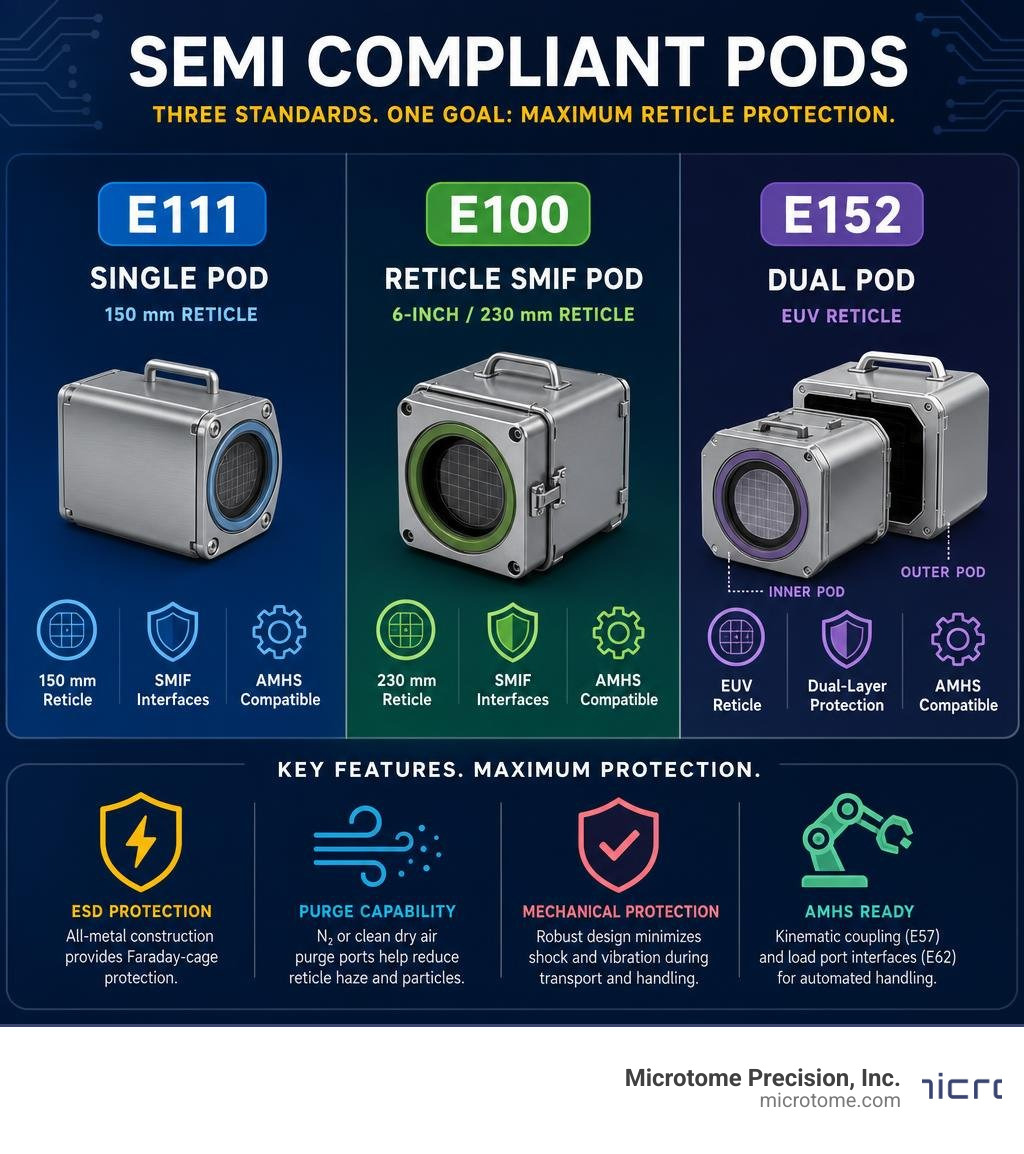
A SEMI compliant pod is a standardized carrier designed to transport, store, and protect photomasks (reticles) in semiconductor manufacturing — built to mechanical and functional specs defined by SEMI standards such as E111, E100, and E152.
Quick answer — what to look for in a SEMI compliant pod:
- SEMI E111 — single reticle pod for 150 mm reticles; required for lithography tool interoperability
- SEMI E100 — reticle SMIF pod (RSP) for 6-inch/230 mm reticles; defines physical interfaces
- SEMI E152 — dual-pod (inner + outer) design for EUV reticles; governs mechanical features
- Material — all-metal pods provide Faraday-cage protection; plastic pods may increase electrostatic risk
- Purge capability — N2 or clean dry air purge ports reduce reticle haze and particle contamination
- AMHS compatibility — kinematic coupling (SEMI E57) and load port interfaces (SEMI E62) for automated handling
Reticles are among the most expensive and fragile components in a semiconductor fab. A single photomask can cost over one million dollars and take weeks to fabricate and qualify. Yet every time a reticle moves — between tools, into storage, or across a shipping route — it faces real risks: particles, mechanical shock, and electrostatic damage.
The problem is that not all pods protect equally. Standard ESD controls designed for wafers don’t translate directly to reticle protection. And for EUV lithography, where conventional pellicle films cannot be used, the stakes are even higher.
That’s where SEMI compliant pods come in — and where choosing the right design matters enormously.
I’m Matt Pilarski, President of Microtome Precision, Inc., the longest-established independent designer and manufacturer of reticle carriers in the industry, with roots going back to 1989 and direct involvement in shaping the SEMI standards that define what a SEMI compliant pod must do. In the sections below, I’ll walk you through the key standards, design differences, and selection criteria so you can make a confident, informed decision for your fab.
Understanding Reticle Carrier Technology
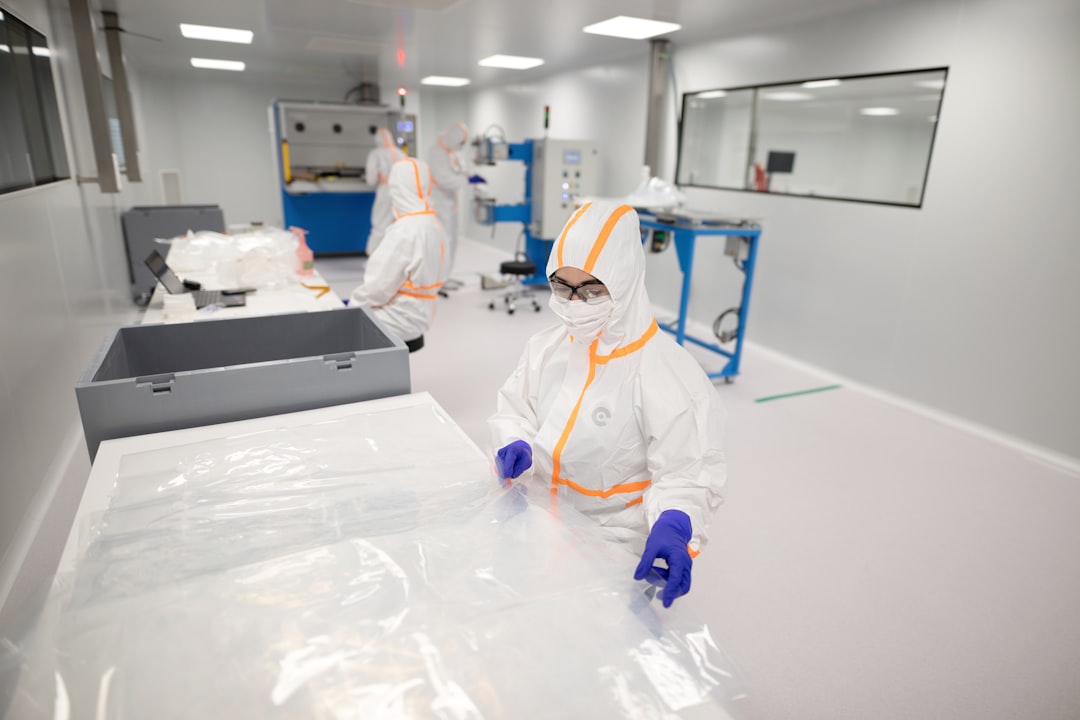
In the early days of semiconductor manufacturing, photomasks were moved manually in simple plastic boxes. As cleanroom requirements tightened and feature sizes shrank, human touch became the leading source of contamination. This drove the industry toward Standard Mechanical Interface (SMIF) technology, isolating the reticle in a mini-environment.
Today, as we navigate the complexities of advanced nodes in 2026, the transition to extreme ultraviolet (EUV) lithography has completely rewritten the playbook. Because EUV light (13.5 nm wavelength) is absorbed by almost all matter, traditional organic pellicles cannot easily be used to protect the mask surface during exposure. This means the reticle carrier itself must act as the primary line of defense against sub-micron particles during transport, storage, and tool docking.
Without strict adherence to global standards, a modern fab would grind to a halt. The global semiconductor supply chain relies on absolute interoperability. A mask fabricated in a merchant mask shop in one corner of the world must fit perfectly into an Automated Material Handling System (AMHS) and dock seamlessly with a lithography tool built by an entirely different OEM.
What is a SEMI Compliant Pod?
At its core, a SEMI compliant pod is a specialized enclosure that adheres strictly to the mechanical, physical, and communication standards established by SEMI (Semiconductor Equipment and Materials International). These standards ensure that the pod can be gripped by robotic overhead hoist transport (OHT) systems, placed onto standardized load ports, and opened by automated tool interfaces without human intervention.
For photomasks, the primary historical standards are SEMI E100 (which defines the physical interfaces of a Reticle SMIF Pod, or RSP) and SEMI E111 (which specifies the mechanical features of a single reticle pod). When you invest in a fully compliant carrier, you are purchasing guaranteed mechanical compatibility across your entire tool fleet.
To explore how these standardized dimensions integrate with modern fab hardware, you can view our complete line of carrier options on our Products Overview page.
Dual-Pod Designs for EUV Lithography
To address the extreme cleanliness demands of EUV lithography, the industry developed the dual-pod concept. Standardized in 2009 under SEMI E152, this design splits the carrier into two distinct parts:
- The Outer Pod: This serves as the mechanical interface for the AMHS, stockers, and tool load ports. It protects the inner assembly from the ambient fab environment and physical shocks.
- The Inner Pod: This directly encloses the reticle. When the dual-pod assembly is loaded into an EUV exposure tool, the outer pod is removed, and the inner pod is transferred into the tool’s vacuum chamber. Only inside the vacuum environment is the inner pod opened to expose the “naked” non-pellicle mask.
To allow the lithography tool to align and track the reticle without opening the inner pod prematurely, the baseplate of the inner pod is standardized into two configurations: Type A and Type B. The Type A inner baseplate includes specialized optical alignment windows and a dedicated window for reading data matrix symbols.
This dual-barrier approach ensures that particles are systematically filtered out during the aggressive vacuum pump-down and venting cycles of the exposure tool. For a detailed look at the physical parameters that govern these interfaces, refer to the official SEMI E100 Specification.
Key Standards Governing the SEMI Compliant Pod
Ensuring that a carrier functions perfectly across different tool brands requires strict compliance with several overlapping standards.

| SEMI Standard | Primary Focus | Key Application |
|---|---|---|
| SEMI E100 | Physical interfaces of Reticle SMIF Pods (RSP) | 150 mm (6-inch) and 230 mm reticle transport and storage |
| SEMI E111 | Mechanical features of single reticle pods | Standardizes the physical footprint for tool load port docking |
| SEMI E152 | Dual-pod mechanical specifications | High-end EUV lithography; includes Type A/B inner baseplates |
| SEMI E109 | Reticle and Pod Management Systems (RPMS) | Software state models and SECS/GEM communication protocols |
| SEMI T4 | Pod identification tag dimensions | RF-ID and barcode placement tolerances on 150/200 mm pods |
These standards are deliberately designed to place minimal limits on material innovation. For example, SEMI E100 and E152 specify critical envelope dimensions, clearance zones, and kinematic coupling points, but they do not dictate whether the pod must be made of plastic or metal. This allows manufacturers to innovate superior contamination-control and electrostatic-shielding technologies while maintaining perfect mechanical interchangeability.
Mechanical and Functional Specifications (SEMI E152 & E111)
Under SEMI E111 and E152, mechanical tolerances are incredibly tight — often measured in tenths of a millimeter. This precision is necessary because even a tiny misalignment during high-speed robotic handling can cause a “pod drop” or generate friction-induced particles.
Furthermore, outgassing is a critical functional parameter. Traditional plastic pods can release volatile organic compounds (VOCs) over time, which deposit onto the reticle surface and form photochemical “haze” when exposed to deep ultraviolet (DUV) or EUV light. To combat this, modern SEMI-compliant designs utilize advanced low-outgassing materials. In premium EUV pods, transitioning from plastic to a metal inner cover has been shown to dramatically reduce outgassing rates, keeping the mask surface pristine for longer production runs.
Automation and Identification Standards (SEMI E109 & T4)
A SEMI compliant pod does more than just sit on a shelf; it constantly communicates with the fab’s Manufacturing Execution System (MES).
The software architecture is governed by SEMI E109, also known as the Specification for Reticle and Pod Management (RPMS). This standard establishes the SECS/GEM communication protocols and state models that equipment must use to coordinate automated pod transfers, verify pod slot maps, and track reticle usage. If you want to dive deeper into the software compliance side of things, you can review the SEMI E109 Specification.
On the hardware side, SEMI T4 defines the exact physical real estate on the pod exterior reserved for mounting barcodes, optical characters, or RF-ID tags. This ensures that overhead readers and load port sensors can identify the carrier without fail. You can find the dimensional requirements for these tag locations in the SEMI T4 Specification.
Particle Protection and Electrostatic Shielding Performance
When evaluating a SEMI compliant pod, physical compatibility is only half the battle. The true test of a carrier is how well it protects the reticle from microscopic particles and electrostatic forces.
Quantifying Particle Protection: The 53 nm PSL Standard
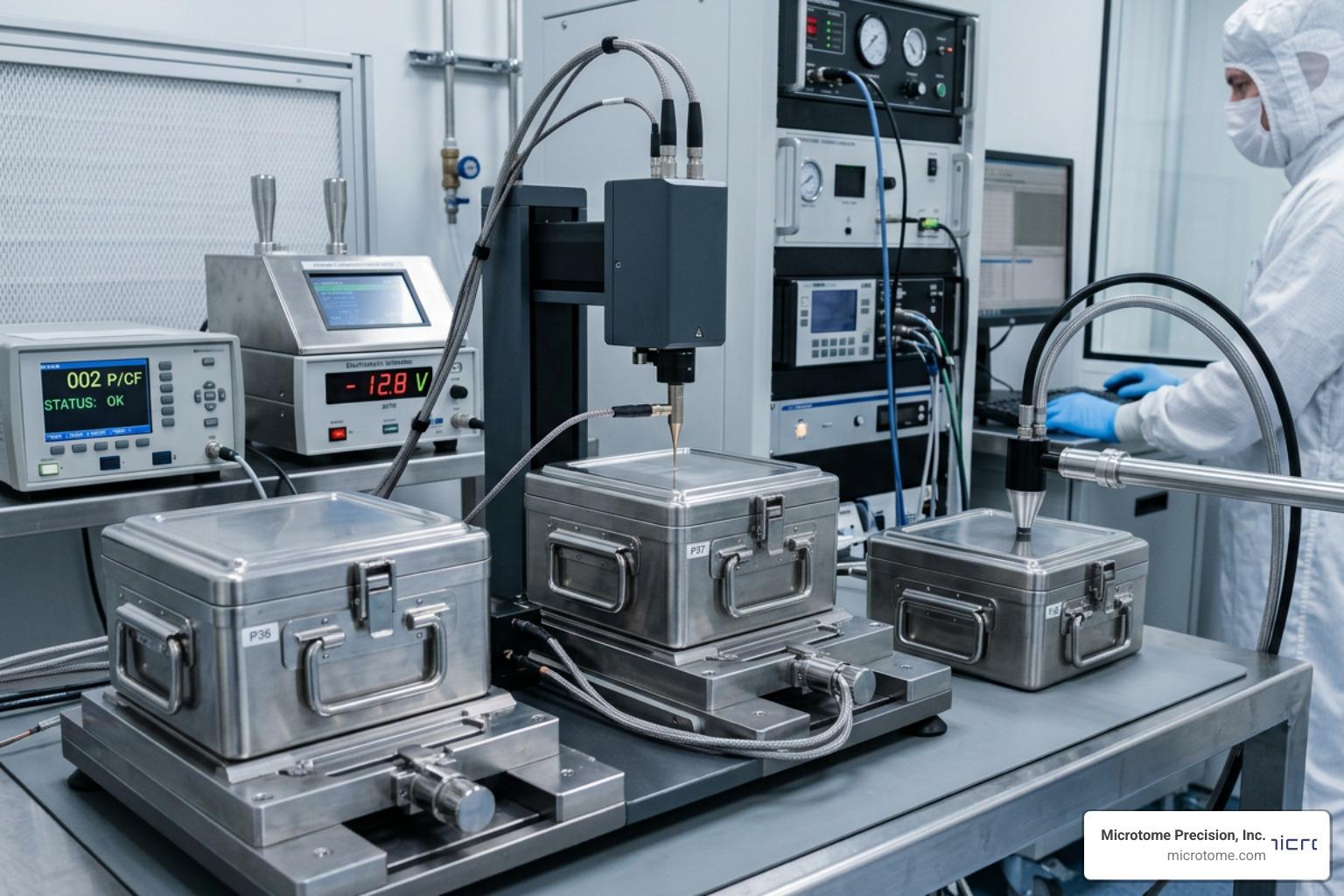
To prove that a pod design is ready for high-volume manufacturing (HVM), it must undergo rigorous particle testing. The industry benchmark for testing EUV pod performance uses 53 nm Polystyrene Latex (PSL) equivalent sphere inspection sensitivity.
During independent evaluations conducted by industry research consortia (such as MIRAI-Selete), pre-production and production versions of SEMI E152-compliant pods (often referred to in literature as “cnPods”) were subjected to simulated shipping, long-term storage, robotic handling, and rapid vacuum pump-down/venting cycles.
The results were outstanding: well-designed dual-pod carriers demonstrated nearly particle-free performance at the 53 nm threshold. This level of protection is essential for maintaining high yield on sub-7nm pilot lines and production environments where even a single 50 nm particle on an EUV mask can ruin an entire wafer die.
Mitigating Electrostatic Risks: EFM and Reticle Haze
Electrostatic charge is the silent killer of photomasks. While most engineers are familiar with Electrostatic Discharge (ESD)—which can melt sub-micron chrome or ruthenium lines on a mask—there is an even more insidious threat: Electric Field induced Migration (EFM).
Discovered and characterized in 2003 by our team at Microtome Precision, EFM occurs at much lower electrostatic stress levels than ESD. When an electric field passes through a reticle carrier, it induces a charge on the isolated metal lines of the photomask. Over time, this electric field causes metal ions to migrate across the glass substrate, leading to progressive line growth, short circuits, and ultimately, a ruined mask.
Many fabs mistakenly believe that using static-dissipative plastic pods solves this issue. It does not. While static-dissipative plastics allow charges to bleed off slowly to prevent sudden ESD sparks, they cannot block external electric fields. The only way to completely shield a reticle from EFM is to place it inside a true Faraday cage.
This is why we pioneer the design of all-metal pods. An all-metal aluminum or titanium carrier acts as an absolute Faraday cage, completely shielding the sensitive reticle inside from external electric fields.
Additionally, to prevent the chemical reactions that cause reticle haze, our pods feature integrated purge ports. By continuously purging the pod interior with nitrogen (N2) or clean dry air (XCDA), we sweep away moisture and trace amines, preventing haze formation. To see how these technologies are integrated into our hardware, explore our All-Metal Pods catalog.
Buyer’s Guide: Selecting and Maintaining Carrier Systems
Choosing the right SEMI compliant pod requires balancing contamination control, electrostatic protection, and long-term operating costs.
Selecting the Right SEMI Compliant Pod for Your Fab
When procuring new carriers, the primary decision comes down to materials: plastic vs. metal.
- Plastic Pods: Often have a lower initial purchase price. However, they are prone to outgassing, cannot shield against EFM electric fields, and degrade over time due to chemical exposure and mechanical wear.
- All-Metal Pods: While requiring a higher upfront investment, all-metal pods offer unmatched durability, zero organic outgassing, and absolute Faraday-cage shielding against EFM. Over the life of a high-value reticle, the reduction in mask damage and haze-cleaning cycles easily offsets the initial cost.
If your fab runs advanced lithography nodes (193nm immersion or EUV), or if you handle high-value reticles that must remain qualified for years, all-metal carriers are the industry gold standard. You can review our specialized metallic designs on our All-Metal SMIF Pods page.
Cleaning, Maintenance, and Interoperability
To keep your pods operating at peak performance, establish a strict maintenance schedule.
First, look for pods designed for easy washability. Some advanced SEMI-compliant designs can be processed through automated cleanroom washers without requiring complete disassembly of the door or internal clamping mechanisms. This drastically reduces maintenance labor and minimizes the risk of re-contamination during reassembly.
Second, ensure your pods are fully compatible with your specific AMHS and lithography tool load ports. Minor differences in kinematic pin positioning or latching mechanisms can lead to docking errors. We recommend verifying tool-pod compatibility early in the procurement phase. You can check our verified hardware configurations on our Compatibility reference page.
Frequently Asked Questions
What is the difference between a plastic and an all-metal reticle SMIF pod?
The primary difference lies in electrostatic shielding and outgassing performance. Plastic pods (even those made with static-dissipative carbon-filled polymers) cannot block external electric fields, leaving the reticle vulnerable to Electric Field induced Migration (EFM). They also outgas trace organic compounds that contribute to reticle haze.
All-metal pods, pioneered by Microtome Precision, act as a complete Faraday cage to block 100% of external electric fields, feature virtually zero outgassing, and offer superior mechanical durability over decades of cleanroom service.
How does a dual-pod system protect EUV reticles without a pellicle?
Because EUV reticles often lack a protective pellicle, they are highly vulnerable to falling particles. A dual-pod system solves this by using two layers.
The outer pod handles transport through the fab and docking on the tool. The inner pod remains sealed inside the outer pod until it enters the tool’s vacuum load lock. During the vacuum pump-purge cycle, the outer pod is removed, and the inner pod is transferred into the ultra-clean vacuum chamber before opening, ensuring that ambient cleanroom particles never find a path to the active mask surface.
Why is EFM protection critical for sub-node lithography?
As feature sizes shrink below 10nm, the metal lines on a photomask become incredibly narrow and tightly spaced. At these microscopic dimensions, even a weak external electric field can trigger Electric Field induced Migration (EFM). EFM causes metal atoms to migrate across the quartz substrate, slowly distorting the mask geometry and eventually causing catastrophic printing defects on the wafer. Traditional ESD packaging does not prevent EFM; only a true metallic Faraday cage can shield against it.
Conclusion
When it comes to protecting your fab’s most valuable assets, compromise is not an option. A truly SEMI compliant pod ensures that your reticles move safely, dock reliably, and remain completely free from the microscopic particles and electrostatic fields that threaten your yield.
At Microtome Precision, Inc., based in Colorado Springs, Colorado, USA, we have spent nearly four decades perfecting the art and science of reticle protection. Since 1989, we have been at the forefront of industry research — discovering EFM, contributing to the creation of SEMI standards, and engineering the world’s finest all-metal SMIF pods and cassettes.
If you are ready to eliminate electrostatic risks, eliminate reticle haze, and secure your lithography yield, our team of experts is here to help. We offer custom engineering, compatibility testing, and comprehensive support to keep your production running smoothly.
To learn more about our ongoing support programs or to submit a service request, visit our Support and Repair page, or contact us directly to schedule a technical consultation.