
The Ultimate Guide to ESD Safe Products

Why ESD Safe Practices Can Make or Break Your Electronics Operation
ESD safe handling is the practice of controlling electrostatic discharge to prevent damage to sensitive electronic components and assemblies.
Here is a quick summary of what you need to know:
| Question | Quick Answer |
|---|---|
| What does ESD safe mean? | All practical measures are in place to prevent electrostatic discharge from damaging components |
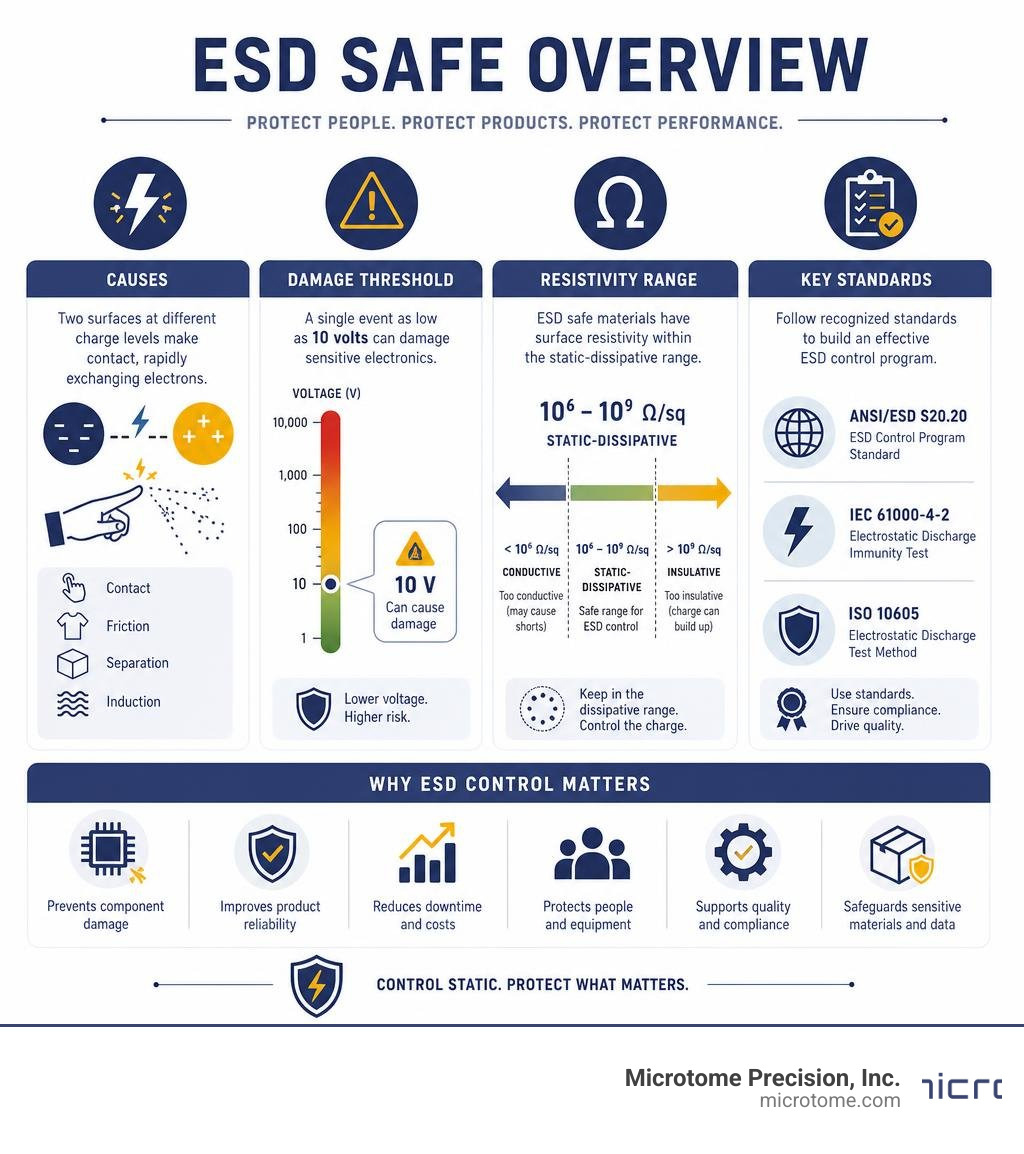
| What causes ESD? | Two surfaces at different charge levels make contact, rapidly exchanging electrons |
| What is the damage threshold? | A single event as low as 10 volts can damage sensitive electronics |
| What materials are ESD safe? | Conductive and static-dissipative materials with surface resistivity of 10^6–10^9 Ω/sq |
| What standards apply? | ANSI/ESD S20.20, IEC 61000-4-2, ISO 10605 |
| Who needs ESD protection? | Electronics manufacturing, semiconductor fabs, cleanrooms, repair labs, aerospace, automotive |
The scale of the problem is easy to underestimate. ESD events cause an estimated $5 billion in annual losses to the electronics industry worldwide. Up to 33% of all electronic device failures are linked to ESD damage — and many of those failures are latent, meaning the component keeps working for a while before failing in the field.
For semiconductor fab managers and mask shop engineers, the stakes are even higher. Reticles — photomasks used in chip lithography — can cost over a million dollars and take weeks to qualify. A single electrostatic event during handling, storage, or transport can render one useless. And standard ESD controls designed for circuit boards are not always sufficient for reticle protection.
I’m Matt Pilarski, President of Microtome Precision, Inc., where we have specialized in ESD safe reticle carrier design and photomask protection since 1989 — including the discovery and characterization of Electric Field induced Migration (EFM), a reticle failure mode that occurs at far lower electrostatic stress than conventional ESD. This guide draws on that experience to walk you through everything from basic ESD principles to advanced protection strategies for the most sensitive environments in modern manufacturing.
Understanding Electrostatic Discharge and What It Means to Be ESD Safe
To understand what makes a product esd safe, we first have to look at the physics of static electricity. At its core, electrostatic discharge is the sudden, rapid flow of electricity between two objects with different electrical potentials.
This process usually starts with charge separation. When two materials rub against each other or come into contact and separate, electrons migrate from one surface to the other. This phenomenon is known as the triboelectric effect. You have probably experienced this yourself when walking across a carpeted room and touching a metal doorknob—the sudden “zap” is a miniature lightning bolt balancing out the electrical potential between your body and the metal.
While a human might only feel a static shock when the voltage exceeds 3,000 volts, electronic components are far more delicate. A single discharge event of just 10 volts can melt microscopic pathways inside an integrated circuit, leading to catastrophic failure (where the device stops working immediately) or latent defects (where the device is weakened and fails unexpectedly later on).
So, What does ESD Safe Mean? | LabPro Inc. explains that being esd safe means taking all practical measures to minimize the risk of electrostatic discharge. This involves using materials, tools, and environmental controls designed to prevent charge accumulation and safely bleed off any static that does build up. In advanced environments, this requires dedicated Static Dissipative Handling protocols to protect components at every stage of the manufacturing workflow.
Conductive vs. Dissipative Materials
When selecting materials for an ESD Protected Area (EPA), you cannot treat all plastics and metals the same way. Materials are classified by their surface resistivity, which is measured in ohms per square ($Omega$/sq).
- Insulative Materials (Surface resistivity $> 10^{11}$ $Omega$/sq): These materials, like standard plastics, glass, and rubber, resist the flow of electricity. Static charges stay trapped on their surfaces, unable to move, creating highly charged “hot spots” that cannot be grounded. Insulators are the enemy in an EPA.
- Conductive Materials (Surface resistivity $< 10^5$ $Omega$/sq): These materials, like metals and carbon-filled polymers, have very low resistance. They allow electrons to flow easily. While they are great for grounding, they can actually cause damage if a highly charged object touches them too quickly, resulting in a rapid, spark-producing discharge.
- Static Dissipative Materials (Surface resistivity $10^5$ to $10^9$ $Omega$/sq): This is the “sweet spot” for handling delicate electronics. Dissipative materials allow electrical charges to flow to ground, but they do so slowly and controllably. This prevents rapid discharge events while ensuring no static builds up on the material itself.
| Material Class | Surface Resistivity ($Omega$/sq) | Charge Transfer Speed | Primary Cleanroom Use |
|---|---|---|---|
| Insulative | $> 10^{11}$ | None (traps charge) | Avoid where possible; requires ionizers |
| Static Dissipative | $10^5$ to $10^9$ | Slow and controlled | Work mats, tool handles, trays, gloves |
| Conductive | $< 10^5$ | Very fast | Grounding wires, metal racks, shielding |
Another critical concept is the Faraday cage. A Faraday cage is an enclosure formed by conductive materials that blocks external static electrical fields. This is why sensitive printed circuit boards (PCBs) are shipped in metallized shielding bags, and why we design our high-end reticle carriers with all-metal pods to block external electric fields entirely.
Key Standards and Testing for ESD Safe Compliance
To ensure consistency and safety across international supply chains, several organizations have established rigorous testing standards. If you are setting up or auditing an EPA, these are the standards you need to know, as detailed in ESD Safety Standards Clearly Explained – Antistat Inc. :
- ANSI/ESD S20.20: This is the primary standard for developing, implementing, and maintaining an ESD control program to protect electrical and electronic parts assemblies.
- IEC 61000-4-2: An international standard that defines the immunity requirements and test methods for electrical and electronic equipment subjected to static electricity discharges, whether from operators or adjacent objects.
- ISO 10605: This standard specifies the ESD test methods for evaluating electronic modules intended for use in road vehicles, taking into account discharges both inside and outside the vehicle.
- AEC Q200: An automotive standard requiring passive components to undergo strict stress testing, including human body model (HBM) ESD testing, to ensure reliability under harsh operating conditions.
Compliance with these standards is verified using specialized testing equipment, such as surface resistivity meters, static field meters, and continuous ground monitors.
Essential ESD-Safe Products for Electronics Assembly and Cleanrooms
Creating an ESD-safe workspace requires a layered defense. You cannot rely on a single wrist strap to protect your entire operation. Instead, an effective setup combines environmental controls, personal grounding, and specialized surface materials.
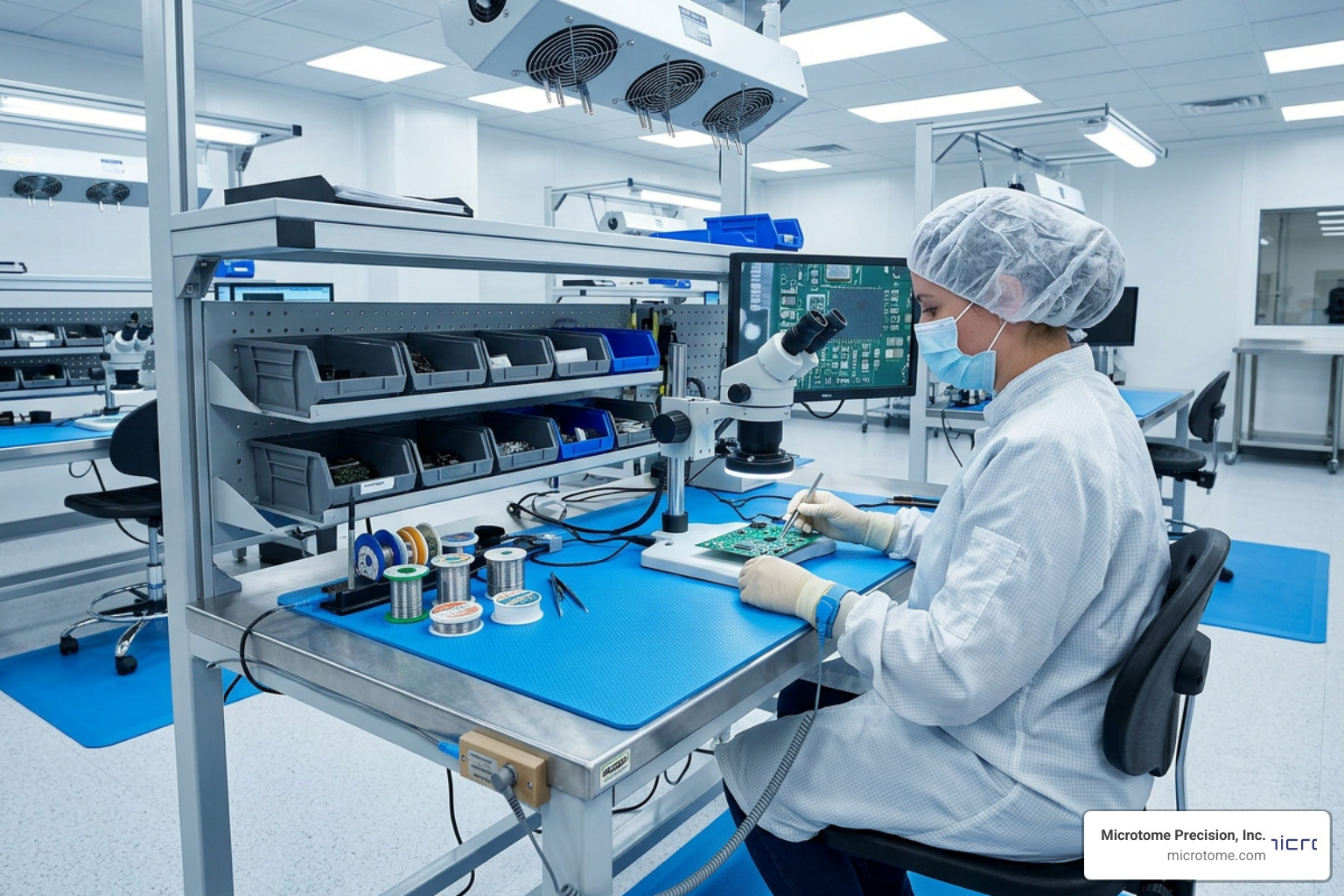
A comprehensive EPA setup typically includes:
- ESD-Safe Table and Floor Mats: These mats are made of dissipative rubber or vinyl and are connected directly to a common point ground. They provide a safe surface to lay down boards and tools.
- Wrist Straps and Grounding Cords: Operators are the primary source of static charge generation. A properly fitted wrist strap drains charge from the body to ground continuously.
- Ionizers: In areas where insulative materials cannot be avoided, ionizers blow a stream of positively and negatively charged ions across the workspace to neutralize static build-up on non-conductive surfaces.
- ESD Gloves and Garments: Standard clothing fabrics can generate thousands of volts of static electricity through simple movement. ESD-safe smocks and gloves feature woven conductive carbon fibers to shield components from clothing-generated fields.
For more information on setting up compliant workstations, you can read ESD safe working is how you do it! – Multitube , which highlights practical layouts for industrial assembly lines.
ESD Safe Tools and Storage Solutions
Even if your workbench is grounded, standard hand tools can still transfer static charges directly to sensitive components. For this reason, professional assembly and repair work require specialized tools.
ESD safe hand tools, such as pliers, tweezers, and screwdrivers, are engineered with dissipative handles (typically with a surface resistivity of $10^6$ to $10^9$ ohms) to safely bleed off charges. Even cleaning equipment must be specialized; standard vacuums generate massive static charges due to high-velocity dust particles rubbing against plastic nozzles. Utilizing specialized ESD-safe vacuums ensures that static charges are safely drained to ground during cleanroom maintenance.
Storage is another crucial piece of the puzzle. Storing components in standard plastic bins is a recipe for latent defects. Instead, operations use modular storage solutions like the ESD Component Drawer Box Anti Static Modular Storage – SKESD , which uses conductive polypropylene to shield components and create a continuous path to ground.
At Microtome Precision, Inc., we apply these exact principles to our high-end semiconductor handling equipment. You can view our full range of solutions on our Products Overview page, or contact our team for specialized Support and Repair services.
ESD-Safe 3D Printing Filaments
With the rise of rapid prototyping and custom manufacturing, 3D printing has become a staple on the electronics factory floor. However, standard 3D printing plastics like PLA, ABS, and PETG are highly insulative. Printing custom jigs, fixtures, or component housings with standard materials can introduce severe static hazards to your assembly line.
Fortunately, material science has caught up. Manufacturers now produce ESD-safe filaments by compounding base resins with conductive additives, such as carbon black or multi-walled carbon nanotubes (CNTs). CNTs are highly favored because they achieve the required dissipative properties with a much lower additive concentration, preserving the base polymer’s flexibility, impact resistance, and ease of printing.
Popular options like Z-ESD – Electrostatic Protection Filament for 3D Printing provide a reliable surface resistivity range of $10^6$ to $10^9$ $Omega$/sq. This allows manufacturers to print custom, chemically resistant electronics casings and assembly fixtures that safely dissipate static without outgassing or shedding particulates in cleanroom environments.
Mitigating Electrostatic Hazards in Advanced Manufacturing
As electronic components shrink, they become increasingly sensitive to electrostatic phenomena. In advanced manufacturing, such as semiconductor fabrication and surface-mount technology (SMT) lines, static mitigation is not just about avoiding device damage — it is also about maintaining chemical purity and preventing industrial fires.

ESD Protection in Fluid Handling Systems
In semiconductor fabs, high-purity chemicals and solvents (such as n-butyl acetate, PGMEA, and NMP) are transported through fluoropolymer tubing made of materials like PFA. PFA is chosen for its extreme chemical inertness and purity. However, PFA is also an exceptional electrical insulator.
When low-conductivity fluids flow through non-conductive PFA tubing at high velocities, charge separation occurs rapidly at the fluid-tube boundary. This can generate static charges on the tubing surface exceeding 20 kV. This extreme voltage presents two severe risks:
- Dielectric Breakdown (Pinholes): The static charge can build up until it sparks through the tube wall to the nearest metal ground, creating microscopic pinholes that cause hazardous chemical leaks.
- Explosion Hazards: If the discharge spark occurs in a solvent-rich environment, it can easily exceed the Minimum Ignition Energy (MIE) of the solvent vapor (e.g., methanol’s MIE is just 0.14 mJ, and acetone’s is 0.19 mJ), leading to catastrophic fires.
To mitigate this without compromising chemical purity, advanced systems utilize specialized ESD tubing featuring coextruded conductive carbon stripes on the outer diameter. These stripes are connected to ground via specialized grounding straps, reducing surface voltages to safe levels (under 1.5 kV). For external surfaces, applying a specialized coating like the Staticide® 6300 ESD Safety Shield can provide an extra layer of humidity-independent static dissipation on plastic brackets, shelving, and conveyor components.
Component-Level ESD Protection
While environmental and handling controls are vital, modern circuit design also incorporates board-level protection to guard against transient ESD events during end-user operation.
Engineers place Transient Voltage Suppression (TVS) diodes, such as the ESD751 data sheet, product information and support | TI.com , on high-speed data lines and power delivery interfaces. These diodes act as ultra-fast voltage clamps. When an ESD event occurs, the diode rapidly drops in resistance, steering the high-voltage transient safely to ground before it can reach sensitive microprocessors.
Additionally, automotive and industrial modules rely on specialized ESD-SAFE™ MLC Chips (Multilayer Ceramic Capacitors). These capacitors are engineered to withstand extreme ESD transients (up to 30 kV) while simultaneously providing essential RF filtering and voltage averaging functions on input/output gates.
Frequently Asked Questions About ESD Safety
What is the difference between antistatic and ESD-safe?
While these terms are often used interchangeably, they mean different things in a technical context. As detailed in What is ESD-Safe? -Newsroom | Unitech Global , antistatic refers to materials that resist the generation of triboelectric charges (usually by keeping surface friction low or retaining moisture). However, antistatic materials do not necessarily dissipate existing charges or shield against external electrical fields. ESD-safe is a broader classification meaning the product has been designed to prevent charge generation, safely dissipate existing charges, and shield against external electrostatic fields.
How often should ESD-safe equipment be tested?
Personal grounding items, such as wrist straps and ESD footwear, must be tested daily before entering the EPA, as sweat, dust, and wear can easily break the electrical path. Stationary equipment like ESD table mats, flooring, and continuous monitoring systems should be verified monthly or quarterly using surface resistivity meters to ensure they remain within the compliant $10^5$ to $10^9$ $Omega$/sq range.
Can standard plastics be made ESD-safe?
Yes. Standard insulative plastics can be temporarily made static-dissipative by applying topical anti-static sprays or conductive coatings. However, for permanent cleanroom applications, these coatings can rub off or outgas. For long-term use, it is highly recommended to transition to inherently dissipative polymers compounded with carbon nanotubes, or utilize all-metal shielding containers.
Conclusion
Implementing a robust, compliant ESD safety program is not a luxury — it is a foundational requirement for modern high-tech manufacturing. From the basic dissipative mats on an assembly workbench to advanced board-level TVS diodes, every layer of defense plays a critical role in preventing catastrophic component failures and costly latent defects.
At Microtome Precision, Inc., we understand that standard ESD solutions are not always enough for the ultra-sensitive requirements of semiconductor lithography. Operating from our state-of-the-art facility in Colorado Springs, Colorado, we design and manufacture industry-leading all-metal reticle carriers and SMIF pods. Our proprietary designs act as complete Faraday cages, protecting multi-million dollar photomasks from both particulate contamination and Electric Field induced Migration (EFM).
If you are looking to elevate your cleanroom protection, we invite you to learn more About Us and our long history of innovation. If you are local to the Colorado area, you can also explore secure storage options through Sales Safes – Colorado Springs, CO .
Let us help you eliminate electrostatic hazards in your most critical workflows. Explore our Electrostatic Protection Consultancy Service today, or get in touch with our engineering team directly via our Products Overview page to discuss your custom manufacturing requirements.