
A Practical Guide to Reticle Protection Pods

Why Reticle Protection Pods Are Critical to Semiconductor Yield
Reticle protection pods are sealed carriers designed to protect photomasks from particles, contamination, and electrostatic damage during storage, handling, and transport inside semiconductor fabs and mask shops.
Quick answer — what you need to know:
- A reticle pod isolates a photomask from the fab environment, preventing particle contamination and electrostatic damage that would otherwise cause lithography defects
- Reticles can cost over $1 million and take weeks to fabricate and qualify — a single contamination event can destroy that investment
- Two primary electrostatic threats exist: ESD (Electrostatic Discharge) and EFM (Electric Field induced Migration) — EFM occurs at far lower stress levels and is the dominant risk
- Plastic pods, including those made from static-dissipative materials, cannot provide complete electric-field shielding — only an all-metal Faraday-cage design blocks EFM
- SEMI standards E111, E112, and E163 define the mechanical and protection requirements for compliant reticle carriers
A reticle isn’t just another fab consumable. At advanced nodes, a single photomask can represent millions of dollars and weeks of qualification work. Yet many fabs still protect these components with carriers that were designed around ESD assumptions — before EFM was even understood as a failure mode.
The stakes are high, and the protection approach matters more than most engineers realize.
I’m Matt Pilarski, President of Microtome Precision, Inc., the longest-established independent designer and manufacturer of reticle protection pods in the industry, where Microtome’s own research team discovered and characterized EFM in 2003. In this guide, I’ll walk through the physics of reticle damage, the differences between pod types and materials, and what genuinely effective reticle protection requires.
The Physics of Photomask Contamination and Electrostatic Damage
To design or select an effective reticle carrier, we must first look at the microscopic threats targeting photomasks inside the cleanroom. In modern lithography, particularly as the industry pushes deeper into sub-3nm nodes, acceptable defect density limits have plummeted. A single particle as small as several nanometers settling on a patterned surface can cause catastrophic circuit pattern distortion, ruining entire wafers and dragging down fab yield.
Traditional contamination control focused almost entirely on physical barriers. However, the movement of airborne particles inside a cleanroom is heavily influenced by electrostatic forces. When a reticle or its carrier accumulates a static charge, it acts as an electrostatic precipitator, actively pulling airborne micro-particles toward the critical mask surface.
Implementing a robust Particle prevention method in reticle pod | TREA requires a dual-pronged engineering strategy: physical isolation and electrostatic mitigation. If either of these areas is compromised, the reticle is exposed to immediate risk. Ensure your equipment interfaces are fully assessed for physical and electrical Compatibility before introducing new carriers to the line.
Understanding EFM in Reticle Protection Pods
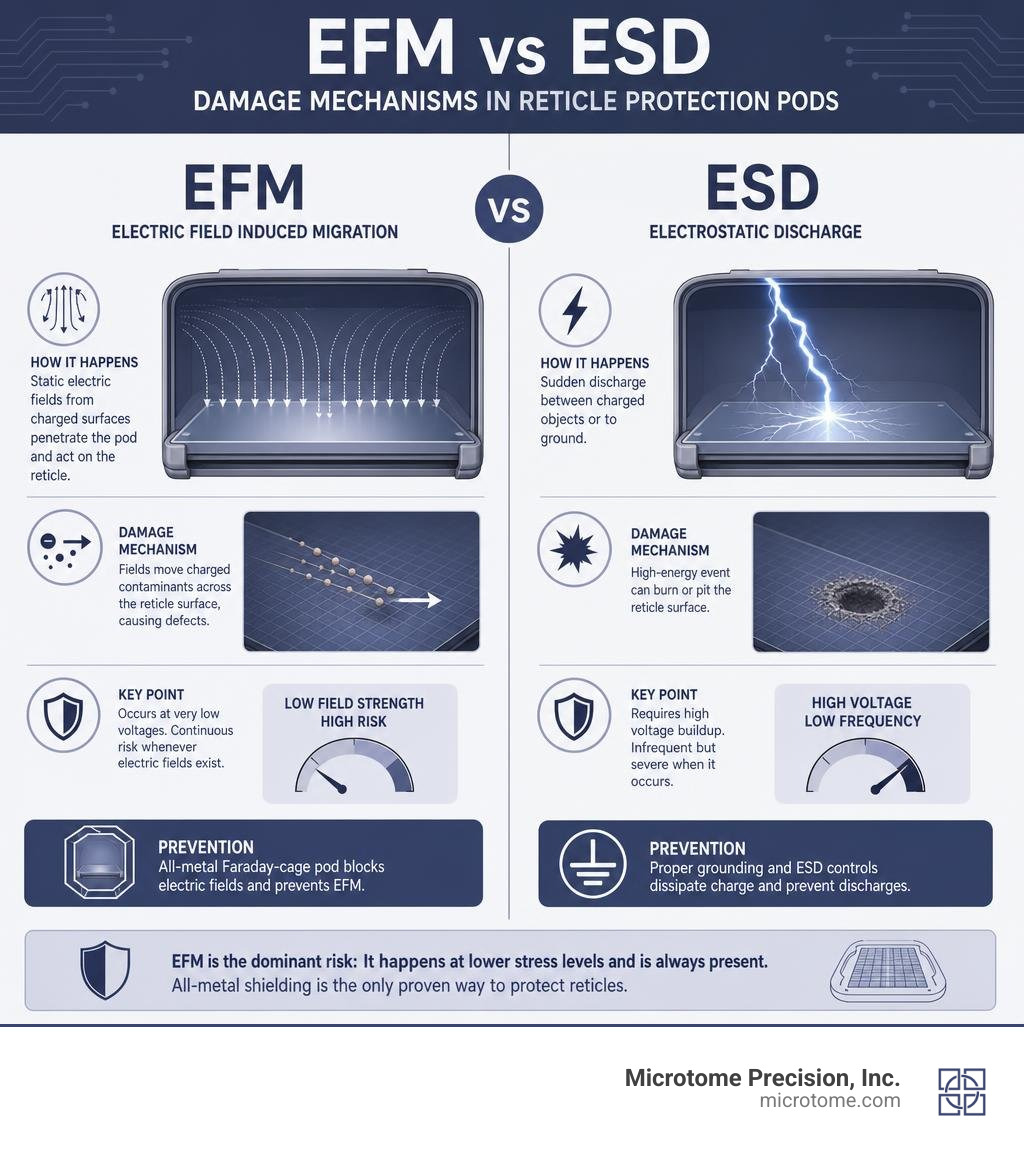
For decades, ESD (Electrostatic Discharge) was considered the primary electrostatic threat in semiconductor manufacturing. But in 2003, our team at Microtome Precision discovered and characterized a far more insidious phenomenon: Electric Field induced Migration (EFM).
Unlike ESD, which requires a rapid, high-voltage spark to jump from one conductive surface to another, EFM occurs under incredibly low levels of electrostatic stress. When an external electric field penetrates a reticle carrier, it induces a localized charge on the photomask’s chrome or metal-silicide absorber lines. This localized field causes metal atoms (such as chrome) to migrate across the quartz substrate.
Over time, this chrome migration creates microscopic “bridges” or dendritic growths between adjacent lines. These growths alter the optical transmission of the mask, resulting in lithography defects during exposure.
The critical takeaway for fab engineers is this: traditional ESD countermeasures can actually increase EFM risk. Static-dissipative plastics, air ionizers, and grounding mats are designed to bleed off high voltages slowly to prevent sudden sparks. However, they do not block electric fields. If a static-dissipative plastic pod is exposed to an external electric field, that field passes straight through the plastic and onto the reticle, driving EFM.
To eliminate EFM, we must prevent external electric fields from ever reaching the photomask. This requires a complete, unbroken Faraday cage, which can only be achieved through all-metal pod construction. For example, our 99100-00 E-Pod is specifically engineered to provide absolute electric-field shielding, keeping the reticle in a zero-field environment.
Particle Prevention and Aerodynamic Control
While electrostatic shielding mitigates EFM and particle attraction, physical particle prevention requires careful aerodynamic and mechanical design. When a reticle pod is opened, closed, or transferred between cleanroom pressure zones, air movement occurs. If this gas flow is turbulent, it can carry ambient particles directly onto the mask.
Modern high-performance reticle protection pods incorporate several mechanical features to manage internal gas dynamics:
- Spoiler Structures and Lengthened Flow Paths: By integrating non-linear spoiler passages and complex sidewall geometries, pods can disrupt high-velocity air currents. This forces incoming air through a tortuous path, slowing it down and trapping suspended particles in dedicated collection spaces before they can reach the central reticle area.
- Diffusion Filters and Pressure Equalization: Rapid pressure changes—such as those experienced during vacuum load-lock transitions in lithography tools—can generate severe turbulence. High-efficiency diffusion filters allow pressure to equalize smoothly without the risk of particle migration.
- Directional Fluid Control: Advanced pods utilize specialized fluid regulating modules. When the pod is opened, a flexible sealing film or directional valve blocks inlet gas flow from directly discharging toward the reticle surface, routing it safely away from critical zones.
Single vs. Multiple Reticle Protection Pods
Depending on the operational stage—whether a reticle is being actively exposed, transported between a local mask shop and the fab, or placed into long-term storage—different carrier configurations are required. These configurations are standardized by SEMI to ensure seamless tool integration.
The global reticle pod market reflects these distinct use cases. According to industry data, the Single Reticle Pod segment commanded 58.3% of the market share in 2025, while Multiple Reticle Pods captured the remaining 41.7%. This distribution highlights the balanced need for both highly secure, tool-compatible single-mask carriers and dense, efficient storage solutions.
This growing global demand—projected to expand from a $0.4 billion valuation in 2025 to $0.7 billion by 2034 at a CAGR of 6.8%—is heavily concentrated in the Asia-Pacific region, which led with a 48.6% market share in 2025 due to massive fabrication capacity in Taiwan, South Korea, and China. North America represented 22.3% and Europe captured 18.1% of the market in 2025, with procurement channels rapidly modernizing as online sales platforms expand at an impressive 12.4% CAGR. To explore these market dynamics further, you can reference the Reticle POD Market Size, Share & Future Analysis 2035 .
| Feature / Specification | Single Reticle Pod (SEMI E111) | Multi-Reticle Cassette (SEMI E112) |
|---|---|---|
| Reticle Capacity | 1 Photomask (typically 6″ x 6″ x 0.25″) | Multiple Photomasks (typically 6 to 12) |
| Primary Use Case | In-tool exposure, automated fab transport | Long-term storage, batch transport, mask shop shipping |
| Automation Interface | Standard Mechanical Interface (SMIF) | Manual or specialized automated storage retrieval |
| Purging Options | Integrated door purge or passive diffusion | Multi-port purging valves for continuous CDA/N2 flow |
| Electrostatic Shielding | Full Faraday cage (all-metal designs) | Collective shielding, optimized for clean storage |
Standardizing Single Reticle Pods for Lithography
Single reticle carriers are the workhorses of the lithography bay. They are designed around the SEMI E111 standard, which defines the exact mechanical dimensions, latching points, and interface features required to interact with automated photolithography tools and Standard Mechanical Interface (SMIF) load ports.
In an automated environment, the single reticle pod must protect the mask during high-speed robotic handling. When the SMIF pod is placed on a tool’s load port, the tool’s elevator mechanism unlocks the pod door and lowers the reticle into the tool’s clean mini-environment.
For maximum reliability during these automated steps, our 99100-00 E-Pod provides a robust, all-metal SMIF-compatible interface. It protects the single reticle from both mechanical shocks and EFM, ensuring that automated pick-and-place arms can reliably access the mask without generating friction-based particles.
Multi-Reticle Cassettes for Storage and Transport
When reticles are not actively scheduled for exposure, storing them individually in single SMIF pods is highly inefficient and consumes massive amounts of cleanroom footprint. This is where multi-reticle cassettes, conforming to the SEMI E112 standard, become essential.
Multi-reticle carriers are designed to hold multiple photomasks securely in a compact, vertical stack. However, storing multiple high-value masks in a single container introduces unique contamination challenges—specifically, the formation of photochemical haze.
Photochemical haze occurs when residual chemical ions (such as ammonium and sulfate) on the reticle surface react with trace moisture and laser light, forming microscopic crystals on the quartz. To prevent this, advanced multi-reticle cassettes incorporate integrated purging valves. These valves allow fabs to continuously purge the cassette’s interior with Clean Dry Air (CDA) or high-purity Nitrogen ($N_2$), reducing relative humidity and chemical concentration levels to near zero.
Our 99600 00 multi-reticle cassette is engineered precisely for this purpose, combining robust physical protection with efficient purge path aerodynamics to keep stored masks pristine.

Material Science and Design Evolution in Reticle Protection
As semiconductor lithography evolved from Deep Ultraviolet (DUV) light sources to Extreme Ultraviolet (EUV) systems, the materials used to construct reticle protection pods had to undergo a radical transformation. EUV lithography operates in a high-vacuum environment and utilizes reflective, rather than transmissive, photomasks. This shift introduced incredibly strict outgassing and particle contamination standards.
EUV-compatible reticle pods represent approximately 22% of the total reticle pod market in 2026, a massive leap from less than 5% in 2020. This growth is driven by the global installation of over 300 EUV scanners. To meet these extreme cleanroom requirements, manufacturers have had to move away from legacy plastic designs. While third-party suppliers continue to offer plastic-based options, our engineering focus remains firmly on all-metal, SEMI-compliant designs that eliminate the inherent flaws of polymers.
The Limitations of Plastic in Reticle Protection Pods
Historically, plastic was the dominant material for reticle carriers due to its low weight and ease of manufacturing. In 2025, the plastic material segment still accounted for 46.2% of the total market value. However, in advanced lithography and high-reliability environments, plastic introduces severe technical liabilities:
- Outgassing and VOCs: Over time, plastic polymers and the plasticizers used in their formulation release Volatile Organic Compounds (VOCs). These outgassed chemicals settle directly on the reticle surface, acting as precursors for photochemical haze.
- Inadequate Electrostatic Shielding: Standard plastics are highly insulative and accumulate massive static charges. To combat this, some pods use static-dissipative or “conductive” plastics. However, these materials only slow down charge transfer—they do not block electric fields. An external electric field passes directly through static-dissipative plastic, exposing the reticle to EFM.
- Mechanical Wear and Particle Generation: Sliding friction between plastic latches and tool interfaces generates microscopic polymer particles, which can easily migrate to the reticle surface.
To overcome these limitations, fabs are increasingly transitioning to all-metal alternatives like our 99400 00 carrier, which provides a clean, non-outgassing, and structurally rigid environment.
All-Metal Construction and Faraday-Cage Shielding
At Microtome Precision, we have pioneered the use of all-metal construction for reticle protection pods. By manufacturing our carriers from high-grade aluminum, we solve the outgassing, mechanical, and electrostatic issues associated with plastic in one elegant design.
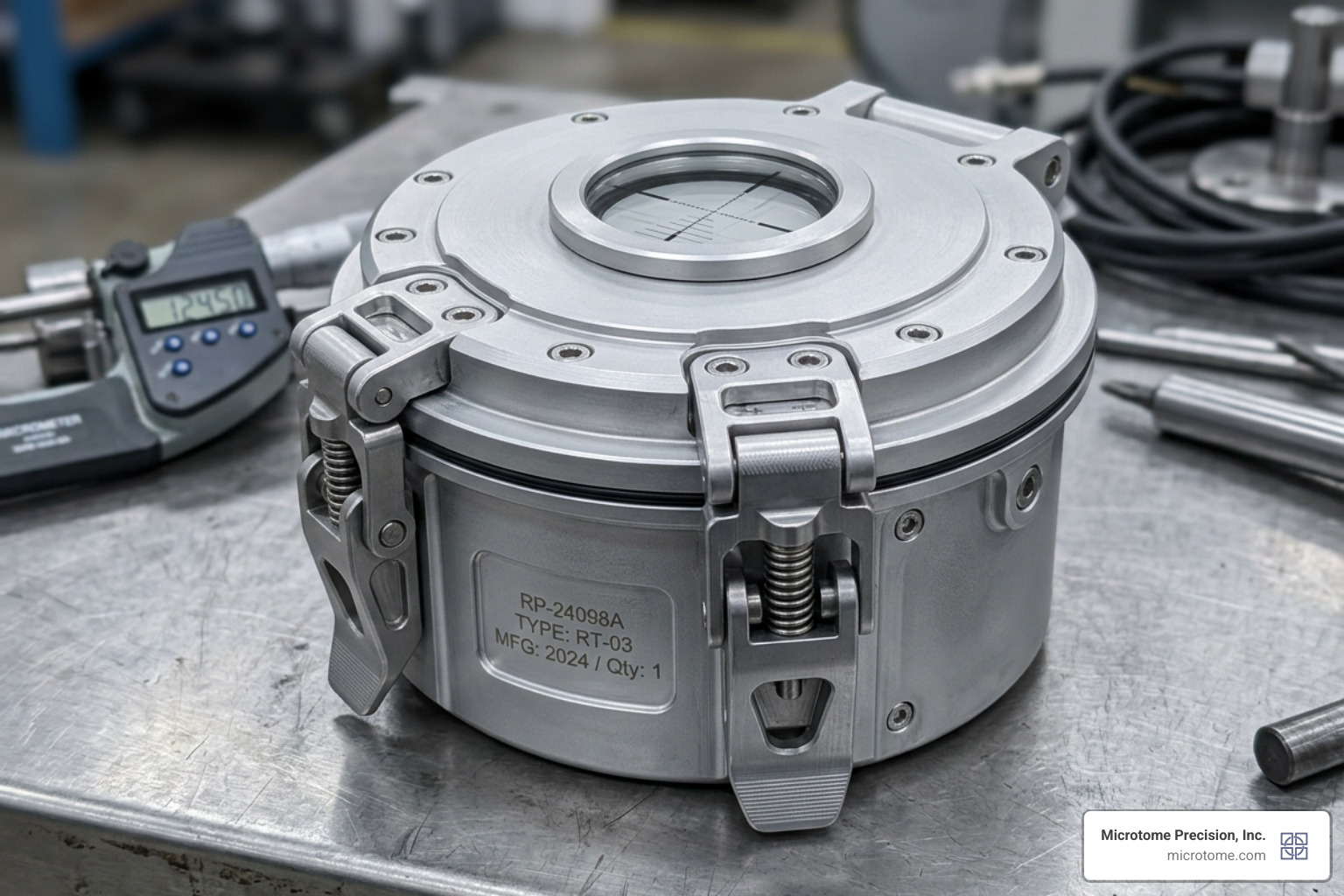
An all-metal pod acts as a perfect Faraday cage. In physics, a Faraday cage is an enclosure formed by conductive material that blocks external static and non-static electric fields. When our all-metal pod is exposed to an external electric field, the charges within the metal aluminum shell quickly redistribute, completely canceling the field’s effect within the pod’s interior.
This means the photomask inside experiences a net electric field of zero. EFM is physically impossible under these conditions.
Furthermore, aluminum does not outgas VOCs, completely eliminating a major source of photochemical haze. Its structural rigidity ensures that the pod maintains precise mechanical alignment with tool interfaces over thousands of cycles without warping or wearing down. To learn more about how our all-metal carriers interface with your existing lithography tools, check our Compatibility specifications.
Frequently Asked Questions about Reticle Pods
What is the difference between ESD and EFM in photomask protection?
While both are electrostatic phenomena, they damage reticles in fundamentally different ways:
- Electrostatic Discharge (ESD) is a high-voltage event where a sudden charge transfer (a spark) occurs between two objects at different electrical potentials. This rapid energy release physically melts or vaporizes the chrome structures on the photomask. ESD typically requires thousands of volts to initiate.
- Electric Field induced Migration (EFM) is a low-voltage, field-driven phenomenon. It does not require a spark or direct contact. Instead, a relatively weak, persistent external electric field polarizes the metal lines on the reticle, causing metal atoms to slowly migrate across the quartz substrate. EFM occurs at voltage thresholds far below those required for ESD and is the leading cause of electrostatic reticle degradation in modern fabs.
Why are all-metal reticle pods superior to plastic alternatives?
All-metal pods provide three critical advantages that plastic pods cannot match:
- Complete Faraday-Cage Shielding: Only a highly conductive metal enclosure can completely block external electric fields to prevent EFM. Static-dissipative plastics allow these fields to penetrate, leaving the reticle vulnerable.
- Zero Outgassing: Metal does not contain plasticizers or volatile compounds, eliminating the risk of chemical outgassing that leads to photochemical haze.
- Superior Durability: Metal pods do not warp, degrade, or generate polymer wear particles over time, ensuring precise tool alignment and a much longer operational lifespan.
What SEMI standards govern reticle protection pods?
The semiconductor industry relies on three primary SEMI standards to ensure reticle carrier interoperability and safety:
- SEMI E111: Defines the physical dimensions, mechanical interfaces, and latching mechanisms for single reticle SMIF pods, ensuring they can seamlessly interface with automated lithography tools.
- SEMI E112: Specifies the requirements for multi-reticle cassettes used in batch transport and storage.
- SEMI E163: Outlines the standards and testing methodologies for electrostatic protection of reticles, establishing guidelines for mitigating both ESD and EFM.
Conclusion
In the highly demanding world of semiconductor manufacturing, protecting your photomasks is directly tied to protecting your yield. Legacy plastic carriers and conventional ESD practices are no longer sufficient to combat the modern threat of Electric Field induced Migration (EFM) and micro-contamination.
Since 1989, Microtome Precision, Inc. has been leading the industry from our headquarters in Colorado Springs, CO. We specialize in custom engineering and manufacturing of SEMI-compliant, all-metal Faraday-cage reticle protection pods that provide absolute protection against EFM and outgassing.
Beyond our standard product lines, we offer specialized Reticle Protection Consultancy Service to help fabs identify and resolve complex electrostatic issues, as well as comprehensive Support and Repair (R&R) services to recertify and extend the life of your existing fleet.
Ready to secure your lithography yield with industry-leading reticle protection? View our full range of Products, connect with our engineering team on Microtome Precision Inc | LinkedIn , or Contact Us today to discuss your facility’s specific requirements.