
The Complete Guide to ESD Products

Why Choosing the Right ESD Products Can Make or Break Your Yield
ESD products are the foundation of any electrostatic control program in semiconductor manufacturing — but not all of them offer the same level of protection, and for some applications, the wrong choice can cause more harm than none at all.
Here is a quick overview of the most common ESD product categories used in cleanroom and fab environments:
| ESD Product Category | Primary Function | Typical Application |
|---|---|---|
| ESD mats and worksurfaces | Dissipate charge from surfaces | Assembly benches, workstations |
| Wrist straps and heel grounders | Ground personnel | Seated and mobile handlers |
| Ionizers | Neutralize charge on insulators | Cleanrooms, where grounding is impractical |
| ESD packaging (bags, totes, trays) | Shield or contain charge during transport | Shipping and storage of sensitive components |
| ESD protection diodes | Clamp transient voltage at the circuit level | PCB and IC design |
| Reticle carriers (SMIF pods, cassettes) | Full electric-field shielding via Faraday cage | Photomask handling in lithography |
Most of these products address electrostatic discharge (ESD) — the sudden transfer of charge between two objects at different potentials. Standard ESD controls like dissipative mats, wrist straps, and ionizers work well for general electronics handling.
But in semiconductor lithography, the threat is different.
Reticles — photomasks that can cost over a million dollars and take weeks to qualify — face a separate and more insidious risk: EFM (Electric Field induced Migration). EFM occurs at far lower electrostatic stress levels than conventional ESD, and standard dissipative or “conductive” plastic carriers cannot stop it. Only complete electric-field shielding — an all-metal Faraday cage — prevents it.
This guide covers the full landscape of ESD products, from general cleanroom controls to the reticle-specific shielding that fab engineers and mask shop managers actually need.
I’m Matt Pilarski, President of Microtome Precision, Inc., the longest-established independent designer and manufacturer of reticle carriers for the semiconductor industry — and our company’s own research first characterized EFM in 2003, fundamentally changing how the industry thinks about ESD products for photomask protection. In the sections that follow, we’ll break down exactly what works, what doesn’t, and why the distinction matters at the reticle level.
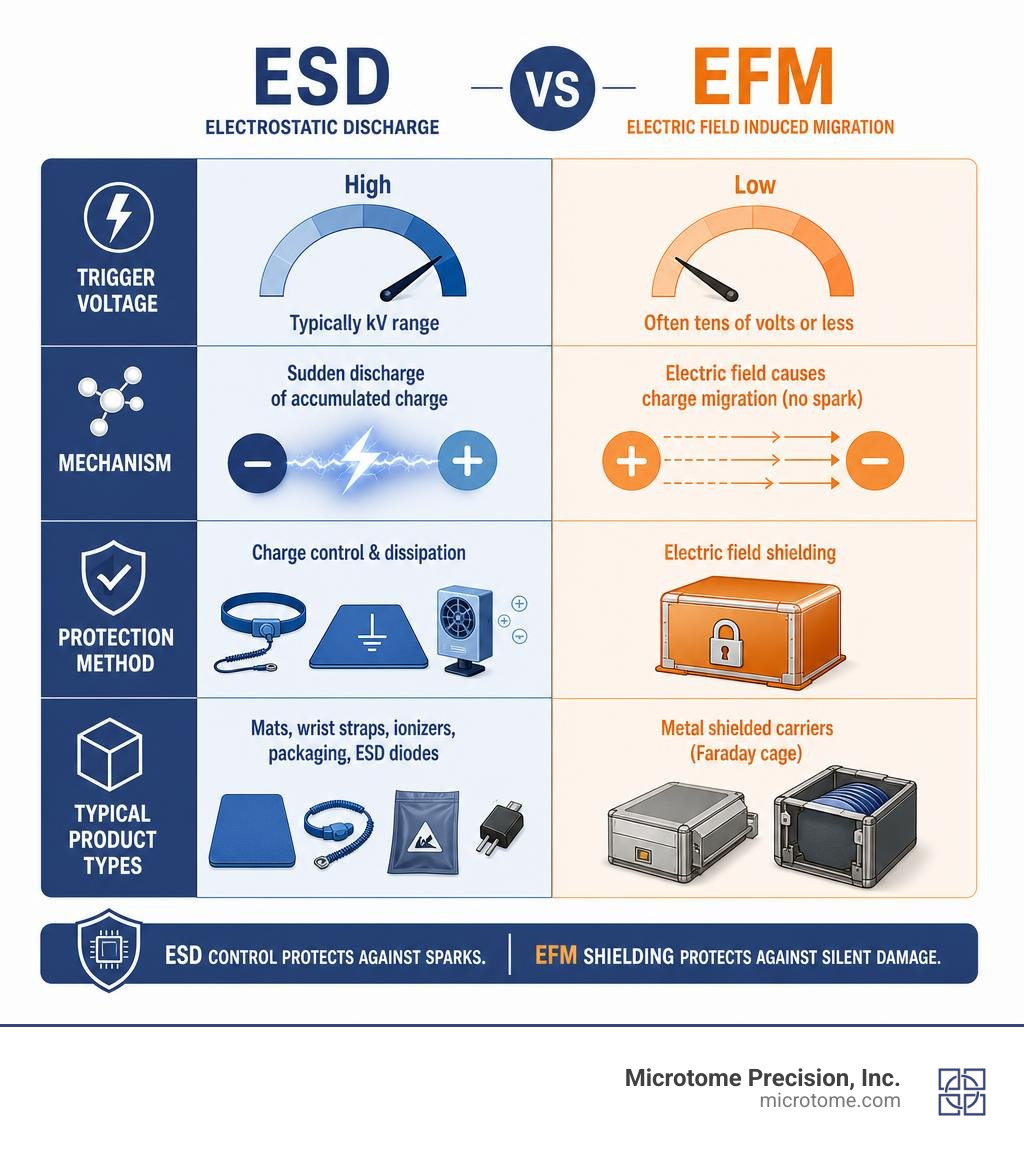
Evaluating ESD Products for High-Yield Semiconductor Environments
When setting up a semiconductor fabrication facility or photomask shop, selecting the correct electrostatic controls is critical to maintaining high device yields. The materials used in esd products are generally classified by their surface resistivity, which dictates how quickly they can transfer or dissipate charges.
- Conductive Materials: Surface resistivity of less than $1 times 10^4$ ohms/sq. These materials allow charges to flow rapidly to ground. While excellent for grounding paths, raw conductive materials can cause rapid, damaging discharges if a highly charged object contacts them directly.
- Dissipative Materials: Surface resistivity between $1 times 10^4$ and $1 times 10^{11}$ ohms/sq. These materials allow charges to flow to ground in a controlled, slower manner, preventing rapid discharge events.
- Shielding Materials: Materials designed to attenuate electrostatic fields and direct discharges around their exterior. For standard electronic components, this is achieved via multi-layer static shielding bags. For reticles, true shielding requires a rigid, highly conductive metal enclosure.
| Material Property | Conductive Plastics | Dissipative Plastics | All-Metal Shielding (Faraday Cage) |
|---|---|---|---|
| Surface Resistivity | $< 1 times 10^4$ ohms/sq | $1 times 10^4$ to $1 times 10^{11}$ ohms/sq | $< 1 times 10^{-2}$ ohms/sq (highly conductive) |
| Charge Dissipation Speed | Fast | Controlled / Slow | Instantaneous |
| Electric Field Attenuation (EFM Protection) | Poor (allows field penetration) | Poor (transparent to transient fields) | Excellent (100% attenuation) |
| Outgassing & Contamination Risk | Medium | High (due to chemical additives) | Zero |
For general facilities maintenance, tools, and workbench areas, engineers rely on trusted suppliers like Desco – Static Control Products and Supplies for ESD Protection to equip personnel with wrist straps, dissipative mats, and grounding cords. In local regions like Colorado, specialist suppliers such as Colorado’s Source: ESD Flooring, Installations, Certifications … and United Static Control Products: ESD Products, Home | United States provide specialized flooring systems that ensure mobile personnel maintain a resistance to ground of less than $1.0 times 10^9$ ohms and a body voltage of less than 100V.
However, when we transition from the general cleanroom floor to the lithography bay where exposed reticles are handled, standard material classifications must be re-evaluated.
Why Standard ESD Control Methods Fail to Protect Photomasks
Standard cleanroom ESD controls are designed around a single premise: preventing a high-voltage spark (ESD) from jumping from a person or a tool to a sensitive circuit. To achieve this, fabs mandate equipotential grounding via wrist straps, dissipative bench mats, and air ionizers to neutralize static on non-conductive surfaces.
While these measures successfully protect silicon wafers and printed circuit boards, they fail to protect photomasks. The primary electrostatic threat to a reticle is not a direct physical spark. Instead, it is EFM (Electric Field induced Migration).
EFM is a physical phenomenon where sub-100V electric fields polarize the sub-micron chrome or MoSi features on a quartz photomask. This polarization creates intense localized mechanical stress, causing the metal structures to migrate, deform, or peel away from the quartz substrate entirely. Because EFM is driven entirely by the presence of an electric field—and does not require a physical discharge or contact—standard dissipative plastics and grounding systems are completely transparent to this threat.
To identify where your process may be vulnerable to these hidden electrostatic fields, we offer specialized diagnostic support through our Electrostatic Protection Consultancy Service.
Cleanroom ESD Products vs. Reticle-Specific Shielding
In a typical cleanroom, active air ionization is often deployed to neutralize charges on insulative surfaces. While ionizers are useful for general contamination control, they have severe limitations when protecting reticles:
- Slow Decay Times: Air ionizers require several seconds—sometimes up to 10 seconds or more—to neutralize a charge on a surface. During those seconds, an unshielded reticle is fully exposed to EFM-inducing fields.
- Unbalanced Ion Output: If an ionizer’s positive and negative emitter pins become dirty or worn, the system can drift out of balance, actually depositing a net electrostatic charge onto the very items it is meant to protect.
- Airflow Obstructions: In a busy lithography bay, automated tool hoods, SMIF indexers, and operator movements block the flow of ionized air, leaving “shadowed” zones where static fields remain completely unchecked.
Passive dissipative plastic reticle carriers are similarly inadequate. While they successfully prevent a rapid electrostatic discharge from occurring on the carrier itself, their high surface resistivity means they cannot block transient electric fields. An external electrostatic field (for instance, from a highly charged operator walking nearby) will pass directly through a dissipative plastic shell, polarizing the reticle inside.
To solve this, we design and manufacture all-metal, Faraday-cage reticle carriers that completely block external electric fields. You can explore our full range of SEMI-compliant solutions in our Products Overview.
The Physics of Electrostatic Protection: ESD vs. EFM
To understand why all-metal shielding is required for photomasks, we must look at the underlying physics.
In a standard ESD event, charge flows from an area of high potential to an area of low potential. If a person accumulates several thousand volts of static charge simply by walking across a cleanroom floor, touching an electronic component will discharge that energy in a microsecond-scale pulse.
In contrast, Electric Field induced Migration (EFM) relies on field theory. According to Gauss’s Law, when an electric field encounters a hollow, highly conductive metal container—a Faraday cage—the free electrons within the metal rapidly redistribute along the outer surface of the container. This redistribution of charge creates an internal electric field that precisely cancels out the external field.
The result? The net electric field inside an all-metal container is exactly zero.
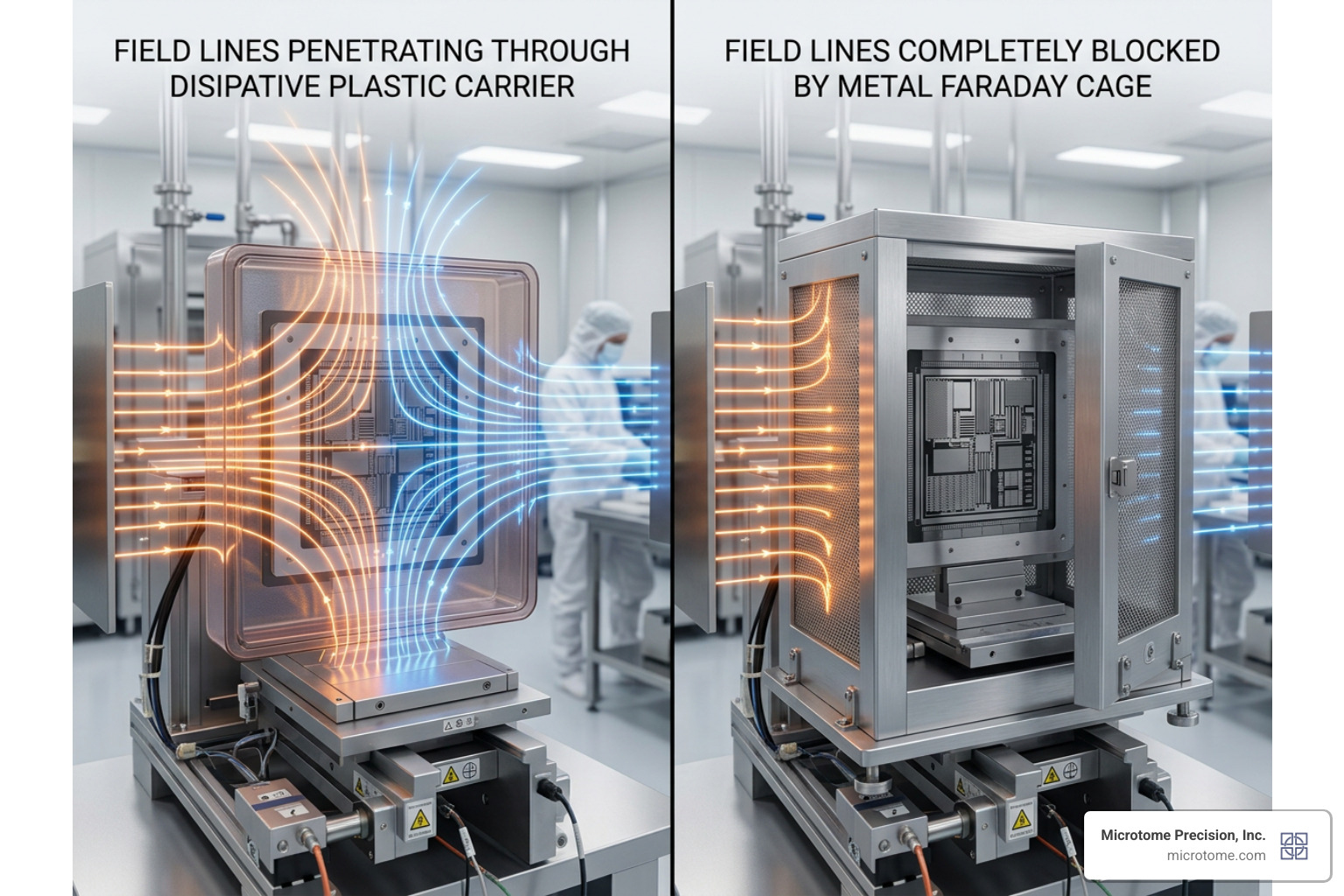
This electrostatic shielding is critical because the threshold for EFM damage on advanced photomasks is incredibly low. While standard integrated circuits can often withstand hundreds of volts of electrostatic stress, sub-micron reticle features can begin to migrate and degrade at field strengths equivalent to less than 100V of potential.
The international standard SEMI E163 establishes guidelines for the handling of electrostatic-sensitive items in semiconductor manufacturing, recognizing that electric fields must be managed with extreme care. Standard dissipative polymers cannot provide the rapid electron mobility required to attenuate these fields, leaving the reticle vulnerable.
The Limitations of Dissipative Plastics in Reticle Carriers
Many commercial reticle carriers, such as standard 150 mm Single Reticle SMIF pods, are constructed using static dissipative polymers with surface resistivities ranging from $10^6$ to $10^{11}$ ohms/sq. While these materials meet basic cleanroom requirements, they present serious operational trade-offs:
- Slow Static Decay: A typical dissipative polymer pod may have a top-to-door static decay time of approximately 10 seconds. In a automated fab, 10 seconds is an eternity. If the pod is handled or moved before this decay is complete, the reticle remains exposed to active electrostatic forces.
- Outgassing and Haze: Dissipative plastics rely on chemical additives, carbon powder, or inherently dissipative polymers (IDPs) to achieve their anti-static properties. Under the high-energy Deep Ultraviolet (DUV) and Extreme Ultraviolet (EUV) light used in modern lithography, these chemical additives can outgas inside the carrier. This outgassed material deposits onto the quartz mask, forming a molecular film known as “reticle haze” which ruins the mask’s optical transmission.
- Mechanical Degradation: Over time, repeated cleanings and exposure to cleanroom chemicals degrade the dissipative properties of plastic carriers, causing their surface resistivity to drift into the insulative range.
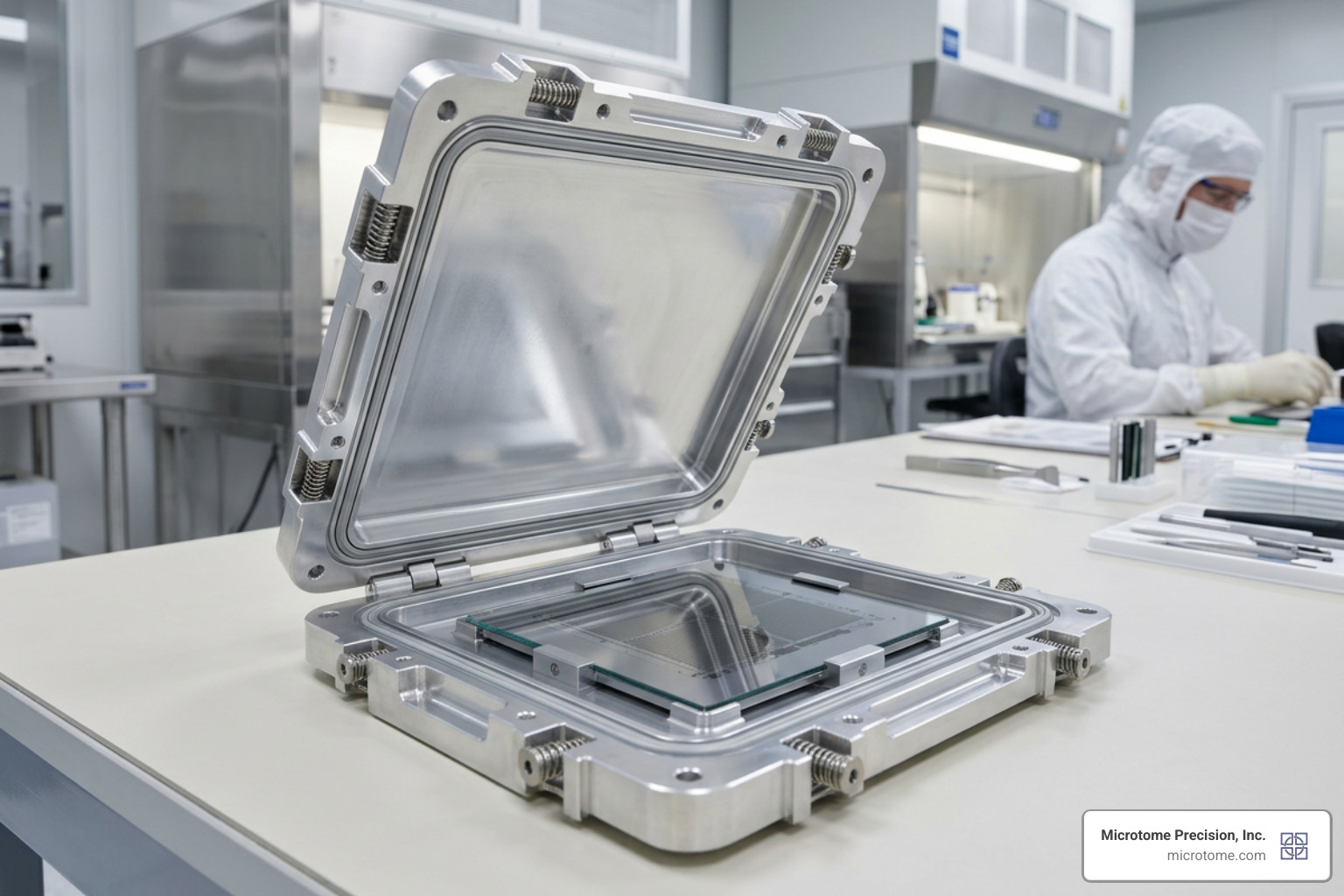
For these reasons, the SEMI E111 standard for single reticle SMIF pods and the SEMI E112 standard for multi-reticle cassettes demand strict mechanical and electrostatic compliance. At Microtome Precision, we bypass the limitations of dissipative plastics entirely by manufacturing our carriers out of precision-machined, high-purity aluminum. Metal does not outgas, it does not degrade, and it provides instantaneous, permanent Faraday-cage protection.
Industry Standards and Compliance for Cleanroom ESD Control
A robust ESD control program must align with recognized international and industry standards. For general electronics assembly and manufacturing, two primary standards govern facility design:
- ANSI/ESD S20.20: This standard provides the administrative and technical requirements for establishing, implementing, and maintaining an ESD control program to protect electrical and electronic parts down to 100V Human Body Model (HBM).
- IEC 61000-4-2: This international standard defines compliance testing for electrostatic discharge immunity at the system level. It simulates real-world ESD strikes that electronics might face during operation.
In circuit design and equipment interface protection, engineers integrate specialized transient voltage suppression (TVS) ESD protection diodes to clamp high-voltage spikes. These components are rated to dissipate severe ESD strikes per the IEC 61000-4-2 standard:
- The ESD751 is a 1.6-pF, $pm24$-V bidirectional ESD protection diode designed for USB power delivery and general-purpose interfaces, rated to dissipate contact strikes beyond the maximum level specified in the IEC 61000-4-2 standard ($pm22$-kV contact and air gap).
- The ESD451 is an ultra-compact 0.5-pF, 5.5-V bidirectional device in an 0201 package, rated to dissipate strikes up to $pm30$-kV (greater than Level 4 compliance).
- The ESD701 offers an ultra-low capacitance of 0.3 pF for high-speed SerDes and HDMI 2.0 interfaces, rated up to $pm15$-kV.
- The ESD7016 – ESD Protection Diode integrates two SuperSpeed pairs, D+, D-, and Vbus lines into a single flow-through package with an ultra-low capacitance of 0.15 pF, specifically designed to protect USB 3.0 interfaces.
- The ESD351 is a 1.8-pF, 3.3-V unidirectional diode rated to dissipate strikes up to $pm30$-kV with extremely low clamping voltage (6.5 V at 16 A TLP).
- The ESD321 is a 0.9-pF, 3.6-V diode rated to dissipate strikes up to $pm30$-kV, ideal for protecting USB 2.0 and Ethernet interfaces.
While these semiconductor-level diodes protect the internal circuitry of lithography tools and computers, the photomasks themselves cannot be protected by diodes. Instead, they rely on physical carriers that comply with SEMI E111 (for single reticle SMIF pods) and SEMI E112 (for multi-reticle cassettes).
Testing and Auditing ESD Control Systems
Maintaining a compliant cleanroom requires regular auditing of all esd products. For general workbench and flooring environments, technicians use surface resistance meters to verify that mats and table surfaces remain within the dissipative range ($1.0 times 10^6$ to $1.0 times 10^9$ ohms). Electrostatic field meters are also used to detect charges on insulative plastics.
However, verifying the shielding effectiveness of a reticle carrier requires specialized testing. Standard surface resistance meters cannot accurately measure the complex geometry of a SMIF pod’s internal shielding.
To ensure that your carriers maintain physical and electrostatic compatibility with your lithography tools, we provide detailed technical specifications and verification protocols through our Compatibility Information portal.
Frequently Asked Questions about ESD Products in Lithography
Why are standard dissipative ESD products insufficient for photomask protection?
Standard dissipative ESD products are designed to slow down the flow of electric current to prevent a physical spark. However, they do not block electrostatic fields. Because photomasks are highly vulnerable to Electric Field induced Migration (EFM) at field strengths below 100V, any transient electric field will pass directly through dissipative plastics and polarize the sub-micron chrome features on the quartz mask, causing catastrophic structural degradation without any physical discharge occurring.
What is the role of SEMI E111 and E112 in reticle carrier design?
SEMI E111 defines the standardized physical dimensions, mechanical interfaces, and automation features for Single Reticle SMIF Pods, ensuring they can be seamlessly handled by robotic indexers on ASML, Nikon, and Canon lithography tools. SEMI E112 defines the standards for multi-reticle cassettes. Compliance with these standards guarantees that the carrier fits perfectly within the fab’s automated material handling systems (AMHS) while protecting the reticles from mechanical shock and contamination.
How does an all-metal Faraday cage prevent electrostatic damage?
An all-metal Faraday cage is made of highly conductive materials (such as aluminum). When an external electric field approaches the container, the free electrons in the metal instantly redistribute across the outer surface of the shell. This surface charge distribution creates an internal electric field that is equal and opposite to the external field, completely canceling it out. The electric field inside the carrier remains exactly zero, keeping the reticle perfectly safe from EFM.
Conclusion
Managing electrostatic risks in a high-yield semiconductor fab requires a clear understanding of the limits of standard esd products. While dissipative mats, grounding straps, and active ionizers are excellent for protecting wafers and general electronics, they are fundamentally incapable of shielding expensive photomasks from the destructive forces of Electric Field induced Migration (EFM).
Since 1989, Microtome Precision, Inc. has been the leading independent pioneer in reticle protection. Operating from our state-of-the-art facility in Colorado Springs, Colorado, we design and manufacture the industry’s only all-metal, SEMI E111 and E112 compliant Faraday-cage SMIF pods and cassettes. By replacing vulnerable dissipative plastics with precision-machined aluminum, we eliminate the risks of EFM, outgassing, and reticle haze.
To secure your lithography yields and upgrade your reticle transport systems, explore our Products Overview, learn about our professional Support and Repair services, or contact our engineering team today to schedule an Electrostatic Protection Consultancy Service.